

In this article
A prospect downloads a guide, disappears for three weeks and returns asking a question your sales team thought had already been answered. That is ordinary buying behaviour, not necessarily a broken funnel.
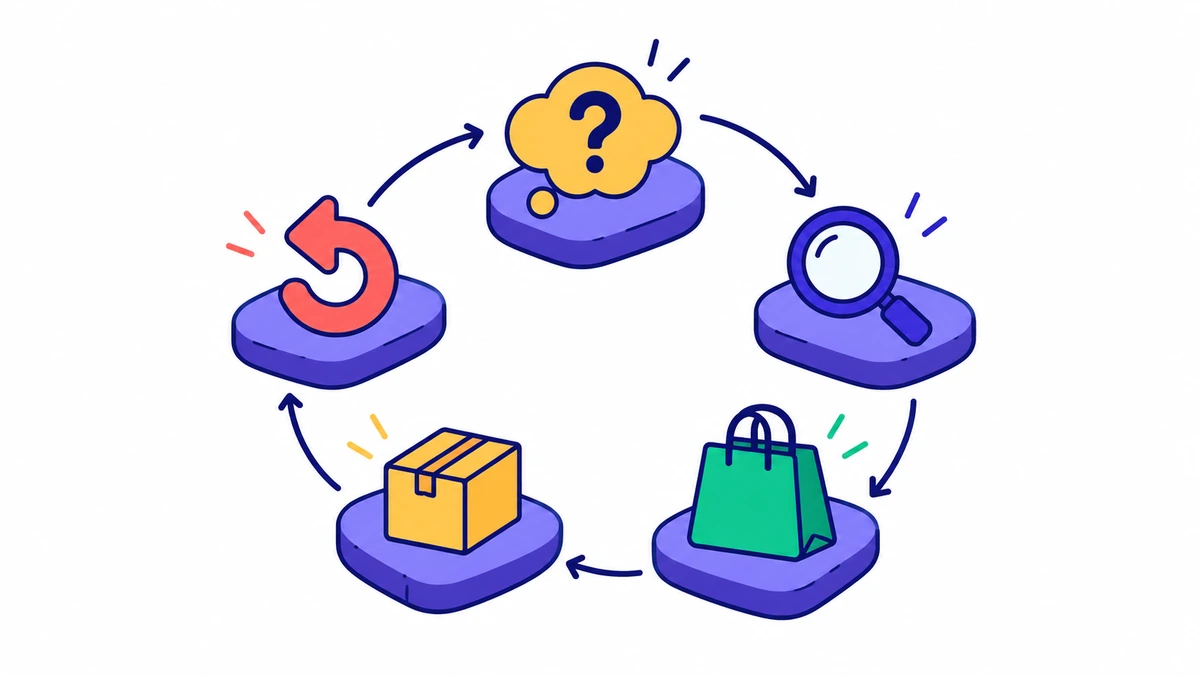
The customer buying cycle is a planning model for the needs people have around a purchase. Use it to identify missing information, while allowing for customers to skip steps, revisit options or decide not to buy.
Start with the trigger
What makes someone pay attention now? It could be a failure, a deadline, a new responsibility or dissatisfaction with an existing option. Ask recent customers what changed rather than assuming every enquiry begins with a search ad.
For a hypothetical restaurant owner, a missed online order might trigger interest in a website project. The underlying need is reliable ordering, not simply a fresher homepage.
Help people understand the problem
Early content should explain the situation, possible approaches and relevant limits. Avoid pushing a detailed proposal before the reader knows what must be decided.
A useful guide can also explain when a service is unnecessary. That helps suitable customers recognise the fit and saves time handling mismatched enquiries.
Need help deciding what to do first? Request a free strategy consultation.
Support evaluation with decision criteria
People may compare price, risk, effort, ownership and ongoing support. Provide scope, process, evidence and tradeoffs. A list of superlatives leaves the reader to invent the criteria.
Google’s messy-middle research describes repeated exploration and evaluation between a trigger and purchase. It is a useful corrective to treating every buyer as a person moving neatly through one sequence.
Make purchase and handover understandable
| Customer question | Information to provide |
|---|---|
| What am I agreeing to? | Scope, price conditions and relevant terms. |
| What happens next? | Timeline, required information and responsible contact. |
| What if something goes wrong? | Support, changes, cancellation or returns as applicable. |
A customer who completes a form but receives no confirmation is still experiencing uncertainty. Test the operational handoff as carefully as the campaign.
Continue after the sale
Provide onboarding, care instructions and a clear support route. Ask for feedback at a stage when the customer can assess the experience. Request genuine reviews without controlling what the customer says.
Useful aftercare can support repeat business, but do not assume every purchase leads to another. Some products are infrequent purchases and some customers have completed their need.
Use the model without intrusive assumptions
Map the questions and information gaps before adding personalisation tools. Tracking does not reveal a person’s complete intentions. The Privacy Commissioner’s behavioural-advertising guidance is relevant when inferred interests and tracking involve personal information.
Review conversion and sales information alongside customer conversations. Note where people hesitate and test a practical improvement. Avoid labelling someone “ready to buy” solely because they viewed a pricing page.
Use our consumer-behaviour guide to research motivations and the customer-experience guide to remove friction. The buying-cycle model earns its value when it helps you answer a question at the right time.